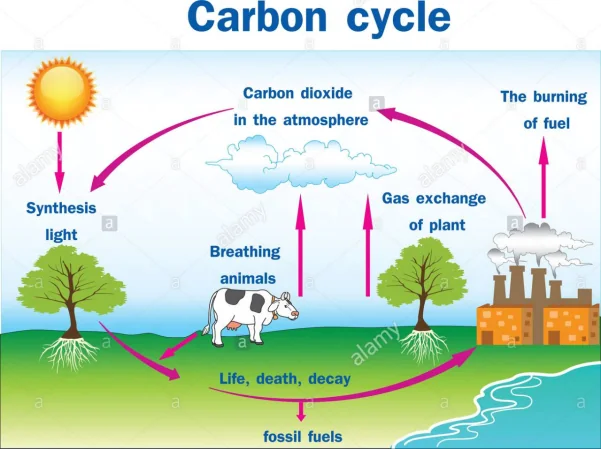
Understand how carbon circulates through the atmosphere, plants, animals, soil, water bodies and human activities—and why carbon is essential to agriculture and life.
Visual overview: carbon moves continuously between living things and the environment.Agricultural Science · Nutrient cycles
Learning objectives
By the end of this lesson, you should be able to:
Define the carbon cycle.
Explain why carbon is a macronutrient.
Describe how carbon dioxide is removed from the air.
List processes that return carbon dioxide to the atmosphere.
State the importance of the carbon cycle to plants and soil.
Relate human activities to carbon circulation.
Key idea
What is the carbon cycle?
Definition: The carbon cycle is the continuous circulation of carbon in nature through processes such as photosynthesis, respiration, decomposition, combustion and exchange with water bodies.
Plants require carbon in large amounts, so it is classed as a non-mineral macronutrient together with hydrogen and oxygen. Plants obtain most of their carbon from carbon dioxide (CO₂) in the air.
C
Non-mineral macronutrients
Carbon, hydrogen and oxygen.
N
Mineral macronutrients
Nitrogen, phosphorus, potassium, calcium, magnesium and sulphur.
🌿
Plant source
Carbon dioxide from the atmosphere, used during photosynthesis.
Follow the cycle
How carbon moves through nature
🌿
Photosynthesis
Green plants remove carbon dioxide from the atmosphere and use it to manufacture carbohydrates and other organic compounds.
Other routes in the cycle
Volcanic activityVolcanoes release carbon dioxide from inside the earth.
Leaching and drainageSome carbon is lost from soil in carbonates of calcium and magnesium.
Food chainsAnimals obtain carbon by feeding on plants or other animals.
Why it matters
Importance of the carbon cycle
🌱
Food production
Plants use carbon dioxide during photosynthesis to manufacture food.
🧬
Organic building block
Carbon forms the structural backbone of carbohydrates, proteins, fats and other organic compounds.
🌾
Soil fertility
Carbon-rich organic matter helps improve soil structure and replenish nutrients.
Real-world connection: Deforestation and excessive fuel burning can disturb the natural balance by reducing carbon uptake and increasing atmospheric carbon dioxide.
Mother-tongue reinforcement
Review the key idea
English summary
The carbon cycle is the continuous movement of carbon in nature. Plants remove carbon dioxide from the air during photosynthesis, while respiration, decomposition and burning return it to the atmosphere.
Question 1 of 5
Assignment
Apply your understanding
Draw a labelled carbon-cycle diagram that includes plants, animals, decomposition, fuel burning and a water body.
State two reasons the carbon cycle is important to agriculture.
Explain how deforestation can change the balance of carbon dioxide in the atmosphere.