
Visual starter: a short animation of water-cycle processes.Prepared from the supplied lesson presentation.
The Water Cycle
Explore how water continuously moves between the earth and the atmosphere—and why this process matters to crops, livestock, soil and year-round agricultural production.
By the end of this lesson, you should be able to:
- Define the water or hydrological cycle.
- Explain how the atmosphere receives water.
- Describe condensation and precipitation.
- Explain infiltration, run-off and groundwater storage.
- Identify three forms of water in soil.
- Discuss the importance of water to crops.
What is the water cycle?
Definition: The water cycle is the continuous movement of water from the earth’s surface to the atmosphere and back to the earth. It is powered mainly by solar energy.
In agriculture, this natural cycle redistributes water to farms, forests and grazing lands. It affects soil moisture, crop growth, livestock water supply and the timing of farming operations.
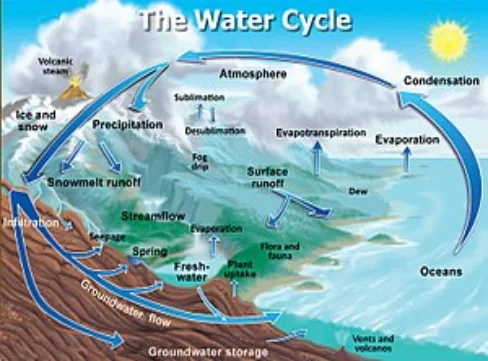
How water moves through the atmosphere
Evaporation
Heat from the sun changes liquid water from oceans, rivers, lakes and wet soil into water vapour.
Remember: Evaporation plus transpiration is called evapotranspiration.
What happens after rainfall?
🌱
Infiltration & percolationWater soaks into the soil and moves downward. This supplies the soil water used by plant roots.
🏞️
Surface run-offWater flows over the ground into streams and rivers. Too much run-off can cause erosion.
💧
Groundwater storageWater moves deeper into the soil and replenishes underground water and the water table.
Importance of water to crops and agriculture
- Crop nutritionWater dissolves mineral salts so roots can absorb nutrients.
- PhotosynthesisWater is an essential raw material used by plants to make food.
- TurgidityWater pressure helps stems and leaves remain firm and upright.
- CoolingTranspiration helps cool plants during hot afternoons.
- Germination and growthWater activates seed processes and supports plant development.
Three forms of water in the soil
| Type | How it is held | Movement | Available to plants? |
|---|---|---|---|
| Hygroscopic water | A thin film tightly held on soil particles | Almost no movement | No |
| Capillary water | Held in small pores between soil particles | Can move sideways or upward | Yes—main usable form |
| Gravitational water | Excess water in larger pores | Moves downward under gravity | Usually drains too quickly |
Ways to conserve soil moisture
Mulching
Cover the soil to reduce evaporation.
Cover cropping
Protect the surface and improve infiltration.
Add organic matter
Humus improves the soil’s water-holding capacity.
Control run-off
Use contour ridges or strip cropping.
Remove weeds
Reduce competition and unnecessary water loss.
Appropriate tillage
Choose practices that preserve soil structure and moisture.
Review the main idea in another language
English summary
The water cycle is the continuous movement of water from the earth to the atmosphere and back. Sunlight drives evaporation, plants add water vapour through transpiration, clouds form by condensation, and water returns through precipitation.
Question 1 of 5
Apply what you have learned
- Draw a neat, labelled diagram of the water cycle in your notebook.
- List five ways a farmer can conserve soil moisture during the dry season.
- Design a simple irrigation system for a school garden and explain how it supports crop production when rainfall is low.
Think like a junior scientist: Observe your community after rainfall. Where does water infiltrate, collect or run off? What could farmers do to manage it better?