
Video lesson: watch the supplied YouTube lesson on bearings.
Open directly on YouTube →
Bearings
Learn how to describe direction accurately using clockwise angles from North, three-figure bearings, back bearings and scale drawings.
By the end of this lesson, you should be able to:
- Explain what a bearing is.
- Identify the bearings of the four cardinal directions.
- Write directions as three-figure bearings.
- Measure a bearing clockwise from North using a protractor.
- Calculate a back bearing.
- Use bearings and scale to draw or interpret a journey.
What is a bearing?
Definition: A bearing is an angle used to describe the direction of one point from another. It is measured clockwise from North.
Imagine that you are standing at point A and looking towards point B. Draw a North line at A, then turn clockwise until you face B. The angle through which you turn is the bearing of B from A.
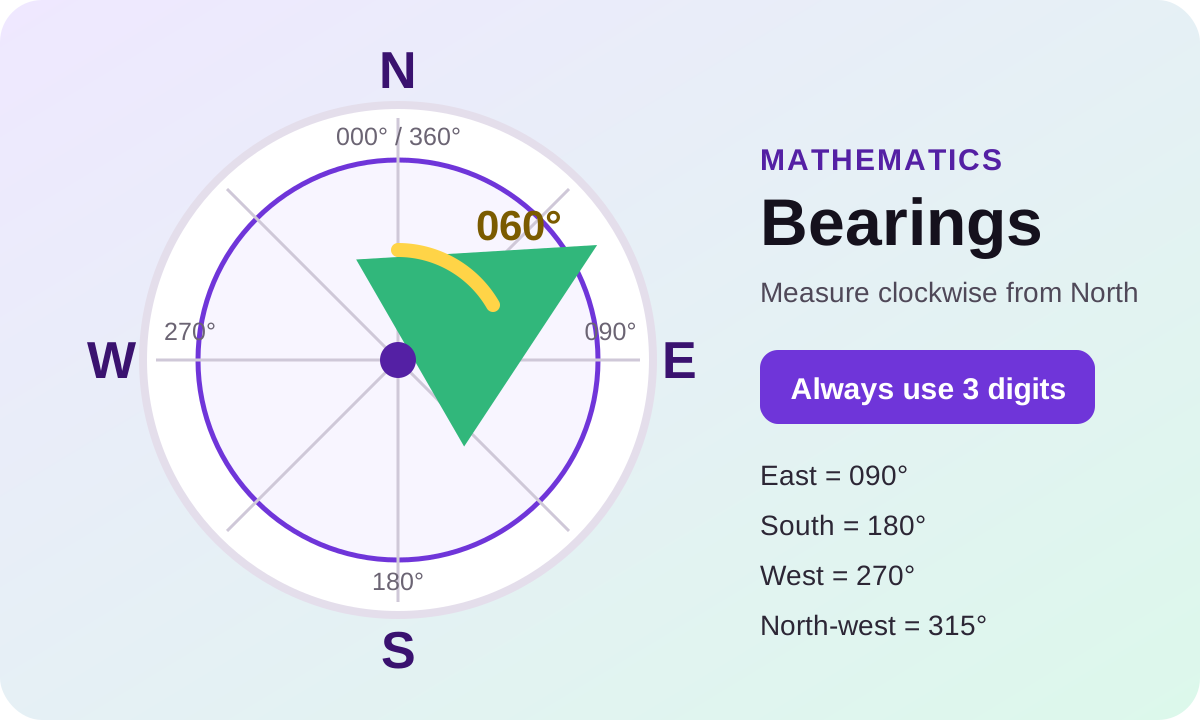
Remember: Start at North, move clockwise, and write the answer with three digits.
Every bearing is written using three digits
A bearing must contain three figures before the degree sign. Add zeroes at the beginning when necessary.
000°
NorthNorth may also be represented as 360° after a complete turn.
090°
EastA quarter-turn clockwise from North.
180°
SouthA half-turn clockwise from North.
270°
WestThree-quarters of a clockwise turn.
Example 1
Write 7° as a bearing
Add two leading zeroes.
Answer: 007°Example 2
Write 45° as a bearing
Add one leading zero.
Answer: 045°How to measure a bearing
1. Mark the starting point
The point named after the word from is the starting point. For the bearing of B from A, begin at A.
Language clue: “The bearing of B from A” means stand at A and look towards B.
Finding a back bearing
The back bearing gives the direction for returning along the same straight line. It differs from the original bearing by 180°.
Back-bearing ruleIf the bearing is less than 180°, add 180°.If the bearing is 180° or more, subtract 180°.
Example 1
Back bearing of 065°
065° + 180° = 245°
Answer: 245°Example 2
Back bearing of 230°
230° − 180° = 050°
Answer: 050°Check: the original bearing and its back bearing must differ by exactly 180°.
Using a scale drawing
Bearings often appear with distances. A scale converts a real distance into a manageable length on paper.
Scale relationshipDrawing length = actual distance ÷ the distance represented by 1 cm.
Worked example
A farm store is 8 km from a school on a bearing of 060°. Draw the route using a scale of 1 cm to 2 km.
- Calculate the drawing length: 8 km ÷ 2 km = 4 cm.
- Mark the school as the starting point.
- Draw a North line through the school.
- Measure 060° clockwise from North.
- Draw a 4 cm line in that direction and label its end “Farm store”.
Accuracy tip: use a sharp pencil, a ruler and a protractor. Small drawing errors can produce incorrect answers.
Where bearings are used
🧭
NavigationTravellers use directions and bearings to follow routes accurately.
✈️
Aviation and shippingPilots and sailors use headings to travel between locations.
📍
Surveying and mappingSurveyors use bearings to establish boundaries, roads and positions.
🚜
AgricultureFarm layouts, irrigation lines and field mapping can be planned using direction and distance.
🏗️
EngineeringEngineers use accurate directions when setting out structures and routes.
🗺️
Rescue and field workTeams can communicate precise movement from one known point to another.
Common bearing mistakes
- Measuring from East or WestBearings always begin at North.
- Measuring anticlockwiseStandard bearings are measured clockwise.
- Using the wrong starting pointRead the phrase “from A” carefully and centre the protractor at A.
- Writing too few digitsWrite 5° as 005° and 70° as 070°.
- Forgetting the scaleConvert the real distance before drawing the route.
Review the main idea in another language
English summary
A bearing is a direction written as an angle. It is measured clockwise from North and is written with three digits. To find the reverse direction, add or subtract 180 degrees.
Question 1 of 6
Apply your understanding
- Write the three-figure bearings of North-east, South-east, South-west and North-west.
- Find the back bearings of 025°, 135°, 205° and 310°.
- Using a scale of 1 cm to 2 km, draw a journey of 10 km on a bearing of 120°.
- Draw three points A, B and C. Choose a bearing and distance from A to B, then another from B to C. Exchange your diagram with a classmate and ask them to measure the bearings.