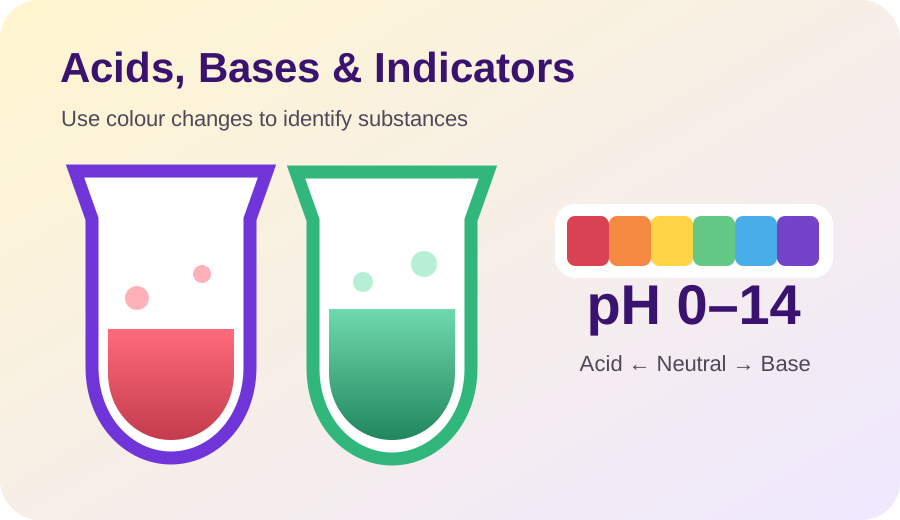
Acids and bases are found in foods, cleaning products, laboratories and the human body. Indicators make their differences visible through colour changes.
JSS 3–SS 130 minInteractive quizOffline-ready
Chemistry • JSS 3–SS 130 min • self-paced
Learning objectives
By the end of this lesson, you should be able to:
Define acids, bases and alkalis.
Interpret the pH scale from 0 to 14.
Predict indicator colour changes.
Explain neutralisation.
Apply basic laboratory safety rules.
Core idea
Acids and bases
Acid: a substance that produces hydrogen ions in water. Many acids taste sour, but laboratory chemicals must never be tasted.
Base: a substance that neutralises an acid. A base that dissolves in water is called an alkali.
🍋
Acid examples
Lemon juice, vinegar and dilute hydrochloric acid.
🧼
Base examples
Soap solution, baking soda and sodium hydroxide.
💧
Neutral example
Pure water is approximately neutral.
Measure acidity
The pH scale
0 Strong acid7 Neutral14 Strong base
pH below 7The solution is acidic.
pH exactly 7The solution is neutral.
pH above 7The solution is basic or alkaline.
Colour evidence
Common indicators
Indicator
In acid
In neutral
In base
Blue litmus
Turns red
Stays blue
Stays blue
Red litmus
Stays red
Stays red
Turns blue
Universal indicator
Red–yellow
Green
Blue–purple
Local investigation: red-cabbage extract can act as a natural indicator, but use only teacher-approved household samples.
Reaction
Neutralisation
Word equationAcid + Base → Salt + Water
Real-life link
Reducing excess soil acidity
Farmers may add lime to acidic soil. The base reacts with acids in the soil and raises the pH towards a range suitable for crops.
Laboratory safety
Handle chemicals responsibly
Never taste chemicalsAppearance and smell cannot confirm safety.
Wear eye protectionUse goggles and follow the teacher’s instructions.
Report spills immediatelyDo not touch or clean an unknown spill without guidance.
Add acid to waterWhen dilution is required, follow the correct supervised procedure.
Mother-tongue reinforcement
Review the main idea
English summary
Acids have pH values below 7, neutral substances have pH 7, and bases have pH values above 7. Indicators change colour, while neutralisation produces salt and water.
Question 1 of 5
Assignment
Apply your understanding
Classify pH 2, 7, 9 and 13 as acidic, neutral or basic.
Create a table showing the effect of acids and bases on red and blue litmus.