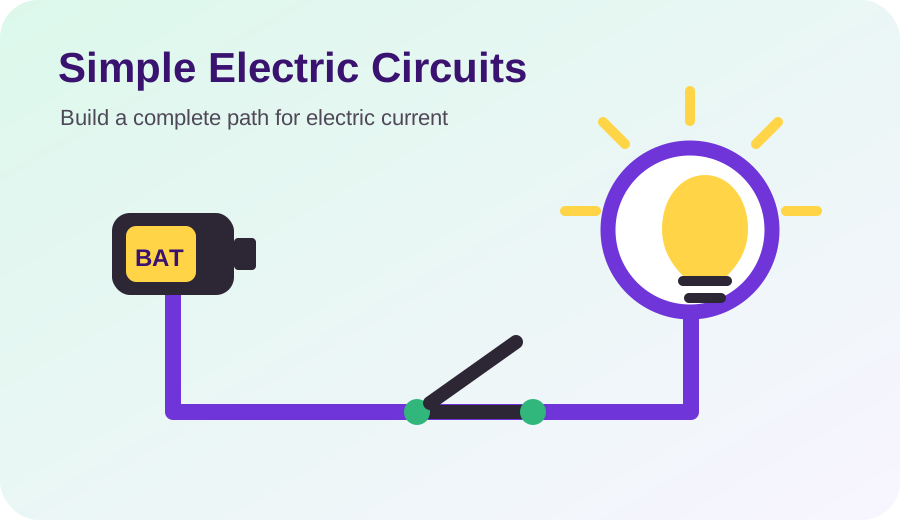
Electric current flows only when components form a complete conducting path. This lesson uses familiar circuit symbols and simple troubleshooting.
JSS 2–325 minInteractive quizOffline-ready
Basic Technology • JSS 2–325 min • self-paced
Learning objectives
By the end of this lesson, you should be able to:
Identify the cell, bulb, switch and connecting wire.
Distinguish an open circuit from a closed circuit.
Compare series and parallel circuits.
Classify conductors and insulators.
Follow basic electrical safety rules.
Core idea
A complete path
An electric circuit is a complete path through which electric current can flow from a source, through components, and back to the source.
Closed circuit
The path is complete
Current flows and a correctly connected bulb can light.
Open circuit
The path is broken
Current cannot flow, so the bulb does not light.
Circuit parts
Know each component
🔋
Cell or battery
Provides electrical energy and potential difference.
💡
Lamp
Converts electrical energy into light and heat.
🎚️
Switch
Opens or closes the conducting path.
➰
Wire
Connects components and carries current.
🛡️
Fuse
Breaks the circuit if current becomes dangerously high.
🔔
Buzzer
Converts electrical energy into sound.
Circuit arrangement
Series and parallel circuits
Series
One path
All components share one route. If one bulb is removed, the whole circuit is broken.
Parallel
More than one path
Branches allow components to work independently. Homes are wired mainly in parallel.
Test materials
Conductors and insulators
Conductors allow electric current to pass easily. Examples include copper, aluminium and graphite.
Insulators resist current. Examples include dry plastic, rubber, glass and ceramic.
Investigation: use only a low-voltage cell circuit under supervision—never use wall electricity for a classroom test.
Stay safe
Electrical safety
Keep water awayWet skin and water can increase the risk of electric shock.
Do not overload socketsToo much current can overheat wires and cause fire.
Replace damaged cablesExposed conductors are dangerous.
Use the correct fuseA fuse is a safety device, not an inconvenience to bypass.
Mother-tongue reinforcement
Review the main idea
English summary
A circuit must form a complete path before current can flow. Series circuits have one path, while parallel circuits have branches. Metals are usually conductors, while plastic and rubber are insulators.
Question 1 of 5
Assignment
Apply your understanding
Draw a labelled circuit containing one cell, one switch and one bulb.
State two differences between series and parallel circuits.
List four conductors and four insulators found around you.