Physics

Simple Machines

Machines make work easier by changing the size or direction of a force. This lesson connects everyday tools to the science of mechanical advantage.

JSS 3–SS 130 minInteractive quizOffline-ready
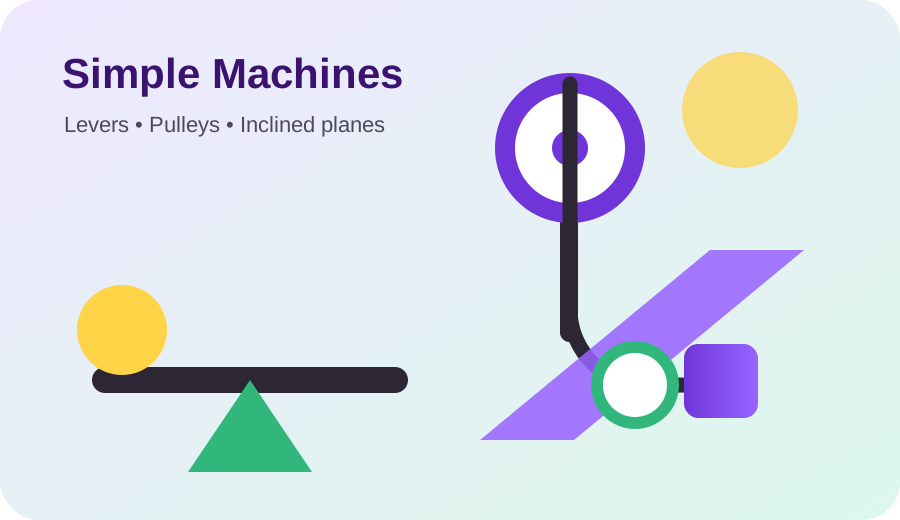
Simple Machines lesson illustration
Physics • JSS 3–SS 130 min • self-paced
Learning objectives

By the end of this lesson, you should be able to:

  • Define a machine and identify common simple machines.
  • Explain effort, load and fulcrum.
  • Calculate mechanical advantage and efficiency.
  • Classify first-, second- and third-class levers.
  • Apply simple machines to familiar situations.
Core idea

What is a simple machine?

A simple machine is a device that makes work easier by multiplying a force, changing its direction, or allowing a force to act over a longer distance.
💪
Effort

The force applied to a machine.

📦
Load

The resistance or object moved by the machine.

⚙️
Machine

The device between the effort and the load.

Six families

Types of simple machines

⚖️
Lever

A rigid bar turning around a fulcrum, such as a seesaw or crowbar.

🛞
Wheel and axle

A large wheel fixed to a smaller axle, such as a doorknob.

🪢
Pulley

A grooved wheel and rope used to lift or change direction.

📐
Inclined plane

A sloping surface that spreads effort over a longer distance.

🔩
Screw

An inclined plane wrapped around a cylinder.

🪓
Wedge

Two inclined planes joined to split or cut materials.

Use the formula

Mechanical advantage and efficiency

Mechanical advantage (MA)MA = Load ÷ EffortEfficiencyEfficiency = (MA ÷ Velocity Ratio) × 100%
Worked example

A machine lifts a 300 N load with an effort of 75 N.

MA = 300 ÷ 75 = 4. The machine multiplies the applied force four times.

Remember: no real machine is 100% efficient because some energy is lost through friction, heat and sound.
Position matters

Three classes of levers

First class

Fulcrum in the middle

Example: seesaw, scissors, crowbar.

Second class

Load in the middle

Example: wheelbarrow, bottle opener, nutcracker.

Third class

Effort in the middle

Example: human forearm, fishing rod, tweezers.

Memory aid: First–Fulcrum, Second–Load, Third–Effort is in the middle.
Mother-tongue reinforcement

Review the main idea

English summary

A simple machine makes work easier. Mechanical advantage compares load with effort. Levers are grouped by whether the fulcrum, load or effort is in the middle.

Question 1 of 5

Assignment

Apply your understanding

  1. List five simple machines used at home or school and state their types.
  2. Calculate the MA when a 500 N load is lifted with an effort of 125 N.
  3. Draw and label one example of each class of lever.