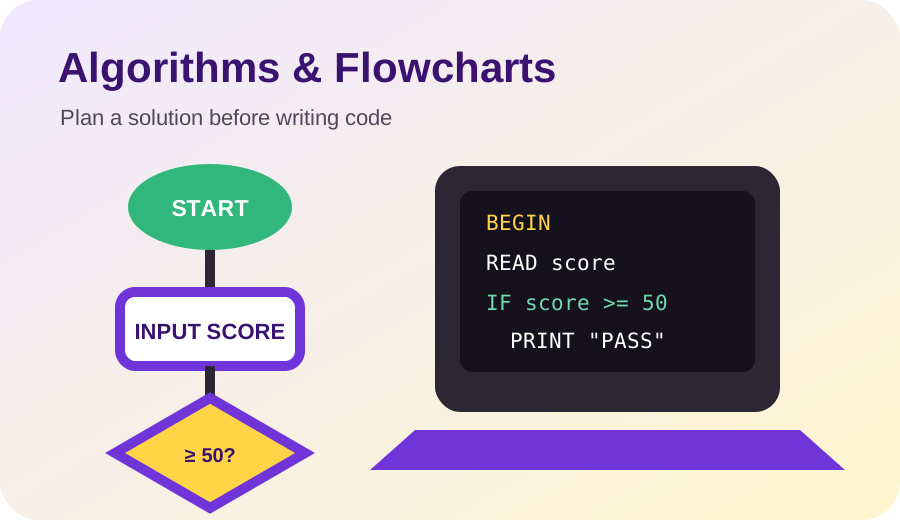
Good programmers plan before they code. An algorithm organises a solution into steps, while a flowchart shows the steps visually.
JSS 2–SS 130 minInteractive quizOffline-ready
Computer Studies • JSS 2–SS 130 min • self-paced
Learning objectives
By the end of this lesson, you should be able to:
Define an algorithm and state its qualities.
Write simple pseudocode using sequence and decisions.
Identify common flowchart symbols.
Trace a simple algorithm.
Apply computational thinking to everyday problems.
Core idea
What is an algorithm?
An algorithm is a finite, ordered set of clear steps for solving a problem or completing a task.
Everyday algorithm
Making a cup of tea
Boil water.
Place tea in a cup.
Pour in hot water.
Wait, then add other ingredients as required.
Serve.
Quality checklist
A good algorithm should be…
🔢
Ordered
Steps follow a logical sequence.
🎯
Unambiguous
Each instruction has one clear meaning.
🏁
Finite
It eventually stops after completing the task.
⌨️
Has inputs
It may receive data needed for the solution.
📤
Has outputs
It produces a useful result.
⚡
Efficient
It avoids unnecessary work where possible.
Visual logic
Common flowchart symbols
StartTerminatorStart or end
ProcessRectangleInstruction or calculation
Yes?DiamondDecision or condition
InputParallelogramInput or output
Worked example
Decide whether a learner passed
BEGIN
  READ score
  IF score >= 50 THEN
    PRINT "PASS"
  ELSE
    PRINT "TRY AGAIN"
  ENDIF
END
The algorithm receives a score, tests a condition and follows one of two branches. This is called selection or a decision.
Trace it: when score = 65, the condition is true and the output is PASS. When score = 42, the output is TRY AGAIN.
Mother-tongue reinforcement
Review the main idea
English summary
An algorithm is a clear, ordered and finite set of steps. Pseudocode expresses the logic in simple words, while a flowchart uses shapes and arrows. A diamond represents a decision.
Question 1 of 5
Assignment
Apply your understanding
Write an algorithm for brushing your teeth.
Draw a flowchart that accepts a number and prints whether it is positive or negative.
Trace the pass/fail pseudocode using scores of 20, 50 and 88.